
Maui County Court Records After Arrest
The arrest-to-court path in Maui County runs through police and custody first, then through the Hawaii Judiciary after filing. The Department of the Prosecuting Attorney for the County of Maui serves Maui, Molokai, and Lanai and prosecutes violations of Hawaii and Maui County criminal and traffic laws. Its felony screening, Circuit Court, District Court, Family Court, investigative, appellate, forfeiture, and victim-witness divisions explain why a booking allegation may not match the final court case. A police arrest can be screened, charged, changed, or declined before the public case record tells the formal story.
Custody records and court records answer different questions. For location, release, and DCR custody status, use Maui County jail inmate records, Hawaii SAVIN/VINELink, and Maui Community Correctional Center contact channels. For booking photos and public-record limits, use the Maui County jail mugshots page. Court records after a Maui County jail arrest show the filed offenses, the court, the case status, hearings, bail or bond information, docket entries, and disposition when that material is public.
The Maui Prosecuting Attorney court-process page describes the basic court split: Circuit Court handles felony cases, District Court handles misdemeanor cases, and Family Court handles juvenile and family or household member cases. That split matters because a person booked after an arrest may later appear in a different court division than expected from the first police allegation.
The Maui Prosecutor court-process page is captured in the project manifest.
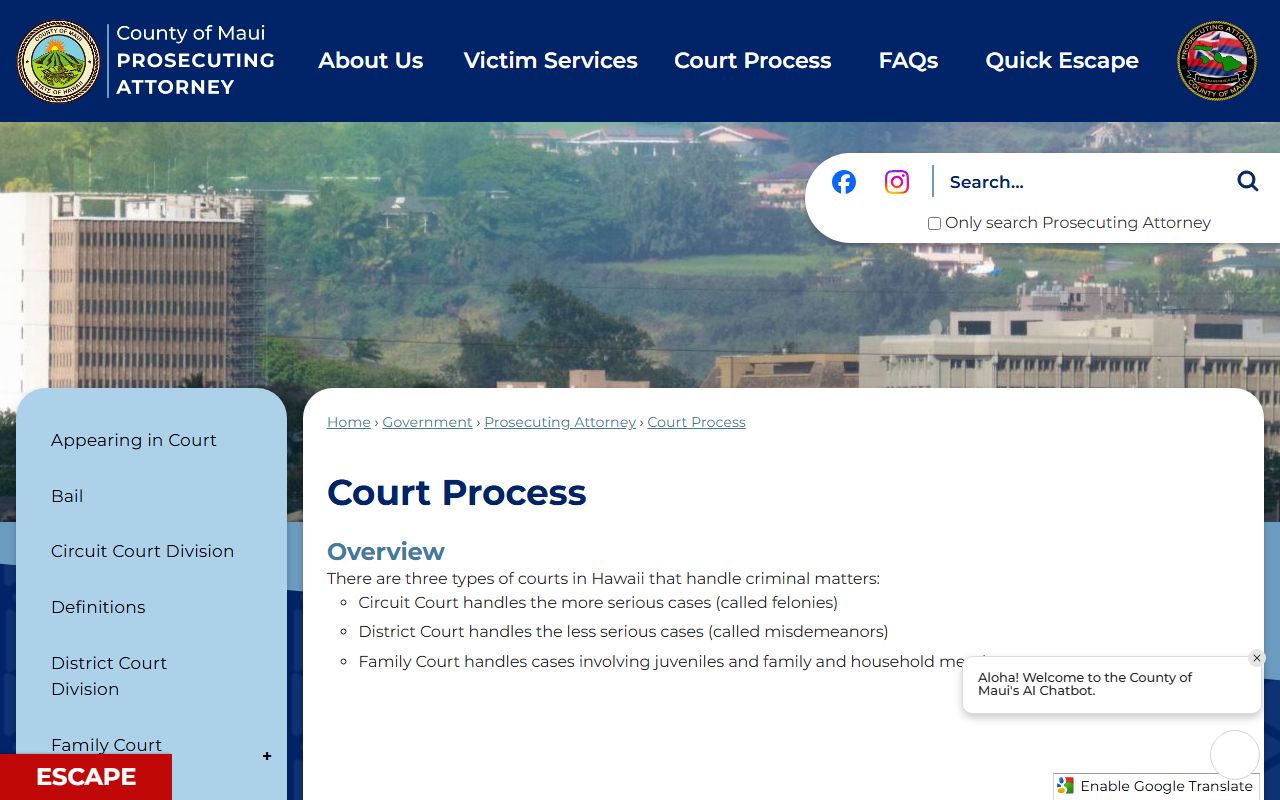
Use that court-process material as a local map for whether the filed case is likely to be a felony, misdemeanor, juvenile, or domestic-violence matter.
Find Maui County Court Records
The main public case-search route is eCourt Kokua. The Hawaii Judiciary says eCourt Kokua covers traffic cases, District Court criminal cases, Circuit Court criminal cases, Family Court criminal cases, civil cases, Land Court, Tax Appeal Court, and appellate cases. It also warns that the online display comes from official records but does not include all public court-record material. Certified court records remain paper records available from the courthouse, and confidential cases, sealed cases, and sealed documents are not available online.
- Confirm custody first if the issue is where the person is held. Hawaii SAVIN/VINELink and MCCC are custody-status channels, not court-charge systems.
- Search eCourt Kokua by person name. Use exact first and last name first, then try phonetic or partial options if the spelling is uncertain.
- Search by Case ID when the number appears on paperwork. Older migrated cases may need the Judiciary conversion format, and Maui is in the Second Circuit.
- Open the case Summary, Case Description, Case Parties, Bail/Bond Information, Events, Dockets, and Offenses tabs where available.
- Compare the filed offense list with the booking allegation. The prosecutor may amend, reduce, add, or dismiss counts after review.
The Hawaii Judiciary Search Court Records page links to eCourt Kokua and explains that certified court records are available in paper form.
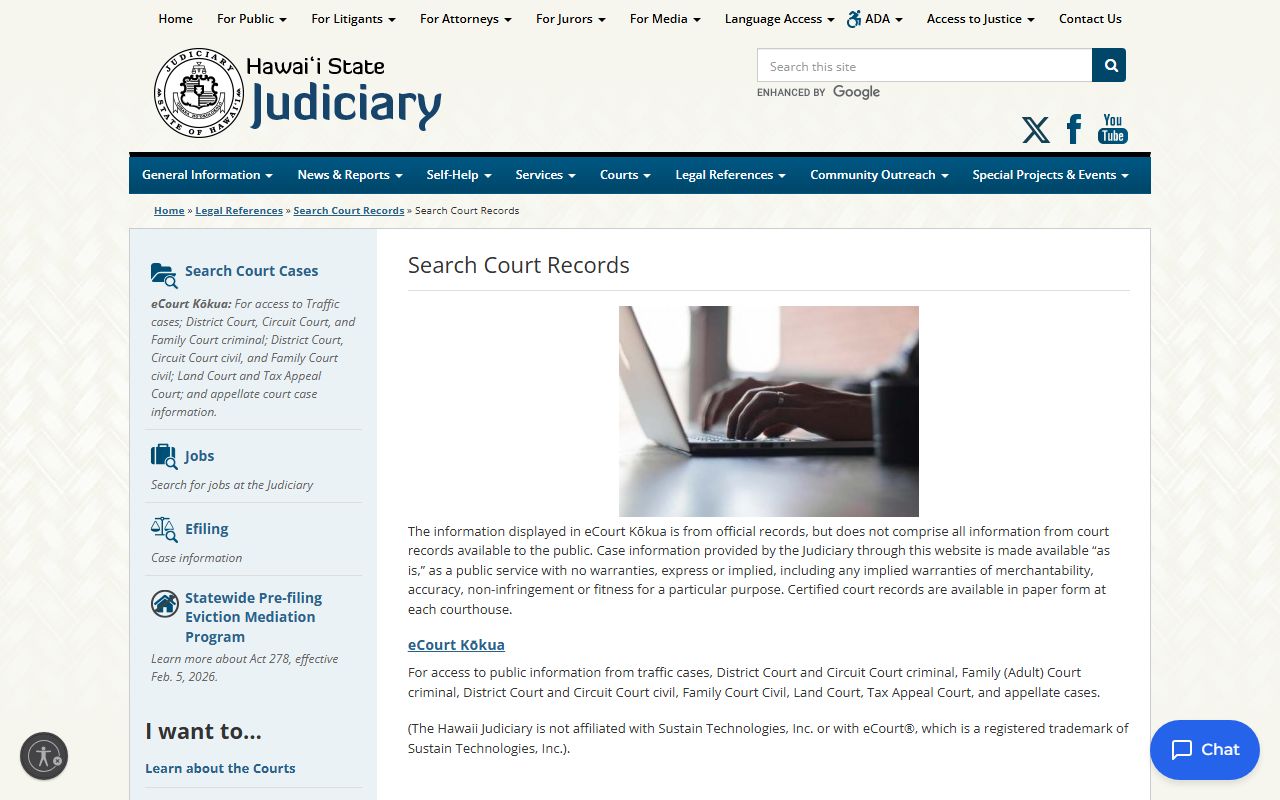
This is the better starting point for formal charges after filing, while jail and police channels remain better for booking, custody, and report access.
Maui County eCourt Search Fields
eCourt Kokua offers several search modes. For most Maui County court records after a jail arrest, person search and case search are the most direct. Filing-date and upcoming-hearing searches help when a case exists but the person has limited information. Some document access costs money, and the Judiciary notes that basic case information may be viewed at no cost while downloadable documents cost $3 per document or $0.10 per page, whichever is greater. Subscription access is listed as $125 quarterly or $500 yearly.
| Search Mode | Field | Required | Notes |
|---|---|---|---|
| Person Search | First Name and Last Name | Yes | Phonetic and partial search options are available. |
| Person Search | Filing date | No | Narrows results when names are common. |
| Person Search | Case type | No | Can narrow to criminal case categories. |
| Case Search | Case ID | Yes minimum | Use the full modern ID or Judiciary conversion rules for old cases. |
| Case Search | Arrest Number, OTN, SID | No | Case-specific fields may help when known from agency paperwork. |
| Filing Date Search | Court, Location, Case Type, Date Range | Yes | For Maui, use Second Circuit and Maui location where applicable. |
| Upcoming Hearings | Case ID or location/date fields | Optional path | Shows hearing calendars and printable views where available. |
The eCourt Kokua portal is also captured as a manifest image.
If a docket entry has no PDF icon, the document is not available for online purchase, even if the record may be public at the courthouse.
Maui County Charging Documents
Formal court records after a Maui County arrest usually begin with a charging document. The document identifies the legal accusation that will be tracked by the court. The research supports the general charging-document terms used in eCourt and court practice: complaint, information, and indictment. Which one appears depends on the case type, screening decision, and court process. The important point is that these documents are court filings, while the arrest report and booking record remain separate agency records.
| Document | Who Uses It | Common Role | Why It Matters |
|---|---|---|---|
| Complaint | Police or prosecutor process | Often starts a criminal case, including many lower-level matters. | May be the first filed charge record after arrest. |
| Information | Prosecutor | Prosecutor-filed charge document used in some felony matters. | Shows the charges the prosecutor chose after screening. |
| Indictment | Grand jury | Grand jury charge document for serious felony cases. | Can replace or reshape earlier allegations. |
Maui County Charge Status
Charge status changes as a case moves. A count can be pending at arraignment, amended by the prosecutor, reduced through plea talks, dismissed by the court, or resolved by a plea or verdict. That is why a jail booking entry, if one is obtained through custody or police records, should not be treated as the final charge list. The eCourt Offenses, Events, Dockets, and disposition fields are better sources for the formal case status after filing.
| Status | Plain Meaning | Record Caution |
|---|---|---|
| Pending | The charge is active and not yet resolved. | Check hearings and bail/bond fields for next steps. |
| Amended | The filed charge was changed. | Compare newer docket entries with the first filing. |
| Reduced | The offense level or count became less serious. | Often appears through plea or amended filing activity. |
| Dismissed | The count or case was ended without conviction on that charge. | Dismissal is not the same as automatic expungement. |
| Disposition | The case or count has an outcome. | Read each count, not just the case caption. |
Maui County Bail and Warrants
Hawaii bail law is in HRS Chapter 804. HRS 804-4 allows bail before conviction where bail is allowable and directs least restrictive conditions needed to ensure appearance and protect the public. HRS 804-9 says bail must be reasonable based on the offense, possible punishment, financial ability, and related facts. HRS 804-11.5 covers cash or card authorization, qualifying personal property, and qualifying Hawaii real property as security.
| Release Term | How It Works in the Research |
|---|---|
| Cash or card bail | Security equal to the bail amount may be allowed under state law. |
| Personal property | Qualifying personal property can be used where accepted under HRS 804-11.5. |
| Real property | Hawaii real property must meet the statutory value rule. |
| PR or own recognizance | Release based on a promise to appear rather than posted money. |
| No-bail hold | Money may not release the person; verify with the court or facility. |
No official searchable Maui active-warrant portal was located in the research. MPD Records Section processes warrants and maintains active NCIC documentation, but that is not a public warrant list. If a warrant is tied to a pending case, eCourt Kokua may show events, bail/bond information, and future hearings. MPD also warns that legitimate agencies do not clear warrants by demanding payment or financial information over the phone.
Maui County Arrest Record Comparisons
A charge is an accusation. A conviction is an outcome after a plea, verdict, or other finding that resolves the charge as proved. For Maui County court records after a jail arrest, this distinction is central. A person may be arrested and charged, yet later have a count dismissed, reduced, amended, or resolved without a conviction on the first-listed offense.
| Point | Charge | Conviction |
|---|---|---|
| Stage | Accusation after filing. | Resolved finding, plea, or verdict. |
| Proof | Not proof of guilt. | Reflects a legal outcome. |
| Where to check | eCourt offenses and dockets. | Disposition, judgment, and conviction records. |
Sealed and expunged records are also different. HRS 831-3.2 governs expungement orders for eligible arrest records and includes photographs, photographic cards, fingerprint cards, and court-record removal procedures. The Judiciary says that as of July 1, 2025, nonconviction arrest-record expungement and related court-record removal requests are handled through a streamlined Attorney General and HCJDC process.
| Point | Sealed | Expunged |
|---|---|---|
| Public access | Hidden from ordinary public access by law or court order. | Treated through Hawaii's arrest-record expungement process where eligible. |
| Online access | Sealed cases and sealed documents are not available in eCourt Kokua. | Related arrest records may be moved to confidential handling. |
| Eligibility | Depends on law or court order. | Depends on HRS 831-3.2 and the actual case outcome. |
Maui County Criminal History Records
eCourt Kokua is not the only record source. Hawaii eCrim is an adult criminal conviction-information service, so it is narrower than a full arrest-to-court timeline. It can help with conviction research, but it should not be used to decide whether someone is in custody at MCCC or whether a fresh arrest has reached court. Police reports and booking-adjacent records route through MPD and Maui County GovQA. Prosecutor records may route through the Prosecuting Attorney request process when the requested material is within that office.
The Hawaii eCrim service is a conviction-information source, not a jail roster or mugshot gallery.
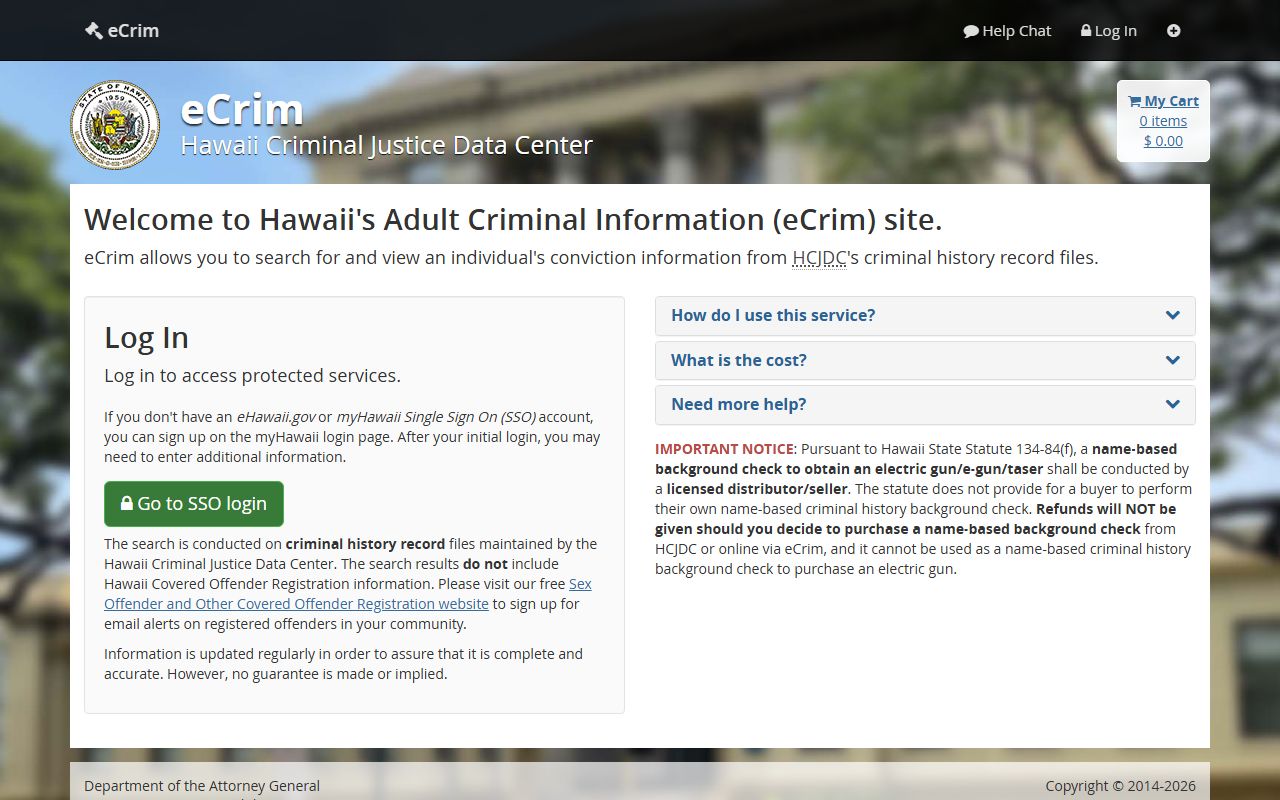
Use eCrim for conviction-focused checks, and use eCourt Kokua for the case path after a Maui County arrest.
Important: This private resource is not a consumer reporting agency, and record lookups cannot be used for FCRA-covered decisions.
Public Record Search
Sponsored Results