
Maui Community Correctional Center Overview
Maui Community Correctional Center, often called MCCC, is the correctional center for Maui County. The operator is the Hawaii Department of Corrections and Rehabilitation Correctional Institutions Division. That detail matters because Maui does not have a sheriff-run county jail roster in the way many mainland counties do. MCCC holds people from Maui County in a unified state correctional system, so local arrest custody, short jail sentences, parole violation custody, and some reentry placements can all meet in the same facility.
The facility is a secure community correctional center in Wailuku. DCR describes Hawaii jails as places for pretrial detainees, very short-term sentenced misdemeanants, and transitional sentenced felons who are returning to the community. MCCC's role fits that description. It houses men and women awaiting adjudication, people serving jail sentences, parole violators, and prison inmates reintegrating to Maui through furlough. A custody lookup for MCCC should therefore separate jail custody from police reports and court charges.
The official DCR MCCC page lists the facility address, phone, visitation hotline, mail resources, phone and tablet notices, deposit information, and program overview.
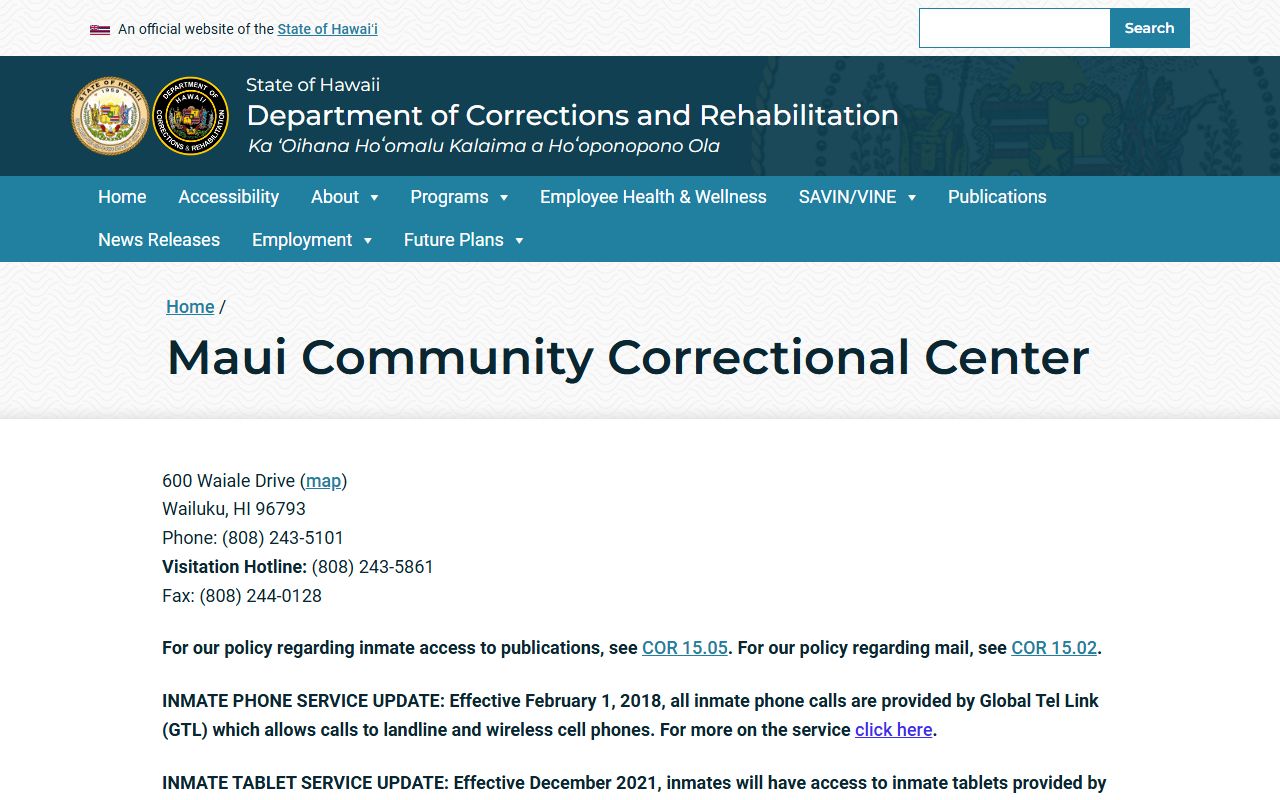
That source is the best starting point for facility rules because it comes from the state agency that operates MCCC.
MCCC Capacity and Population
DCR's 2025 Correctional Institutions Division legislative report says Maui Community Correctional Center was built in 1978 with capacity for 24 inmates. The same report says the facility now has a design capacity of 209 and an operating capacity of 301. It also gives an FY 2024 average headcount of 195. Later population reports and oversight tours show why both capacity numbers should be read with care. A count can be above design capacity but still below operating capacity.
The DCR end-of-month population report for March 31, 2026 listed MCCC at 212 head count, with 183 male and 29 female. The assigned count was 218, with 186 male and 32 female. "Head count" is the physical count reported for that date. "Assigned count" can differ because a person may be assigned to MCCC while counted in a different line or status. The March 2026 head count was above the design capacity but below operating capacity.
| Measure | Figure | Source |
|---|---|---|
| Original 1978 capacity | 24 | DCR 2025 legislative report |
| Design capacity | 209 | DCR 2025 legislative report and March 31, 2026 population report |
| Operating capacity | 301 | DCR 2025 legislative report and 2026 population reports |
| FY 2024 average headcount | 195 | DCR 2025 legislative report |
| March 31, 2026 head count | 212 total, 183 male, 29 female | DCR end-of-month population report |
Look Up MCCC Inmates
No official public MCCC roster was located in the research. Do not expect a Maui County jail roster page with booking photos, charge rows, bond amounts, and housing units. The official custody route found for Hawaii DCR is Hawaii SAVIN through VINELink. SAVIN provides free, anonymous, confidential custody and parole status information and notifications for offenders under DCR jurisdiction. It is a custody-status and notice system, not a full police report or court charge file.
Use the chain below when a Maui County inmate lookup does not return a simple public roster result. Each channel answers a different question. MCCC and SAVIN address custody status and facility routing. MPD records address police reports and arrest-related local records. Hawaii Judiciary eCourt Kokua addresses court records after charges are filed.
- Search Hawaii SAVIN or VINELink for DCR custody or parole status connected to MCCC.
- Call MCCC for facility procedure, visitation, mail, or routing questions that a public notice system does not answer.
- Use Maui Police Department records for police reports and arrest-related documents.
- Search eCourt Kokua after a court case exists to review filed charges, case status, bail or bond fields, dockets, events, and offenses.
- Use BOP or ICE tools only when the person may be in federal or immigration custody, not state DCR custody.
The Hawaii SAVIN source page explains web, phone, app, and TTY notification access for state custody and parole status.
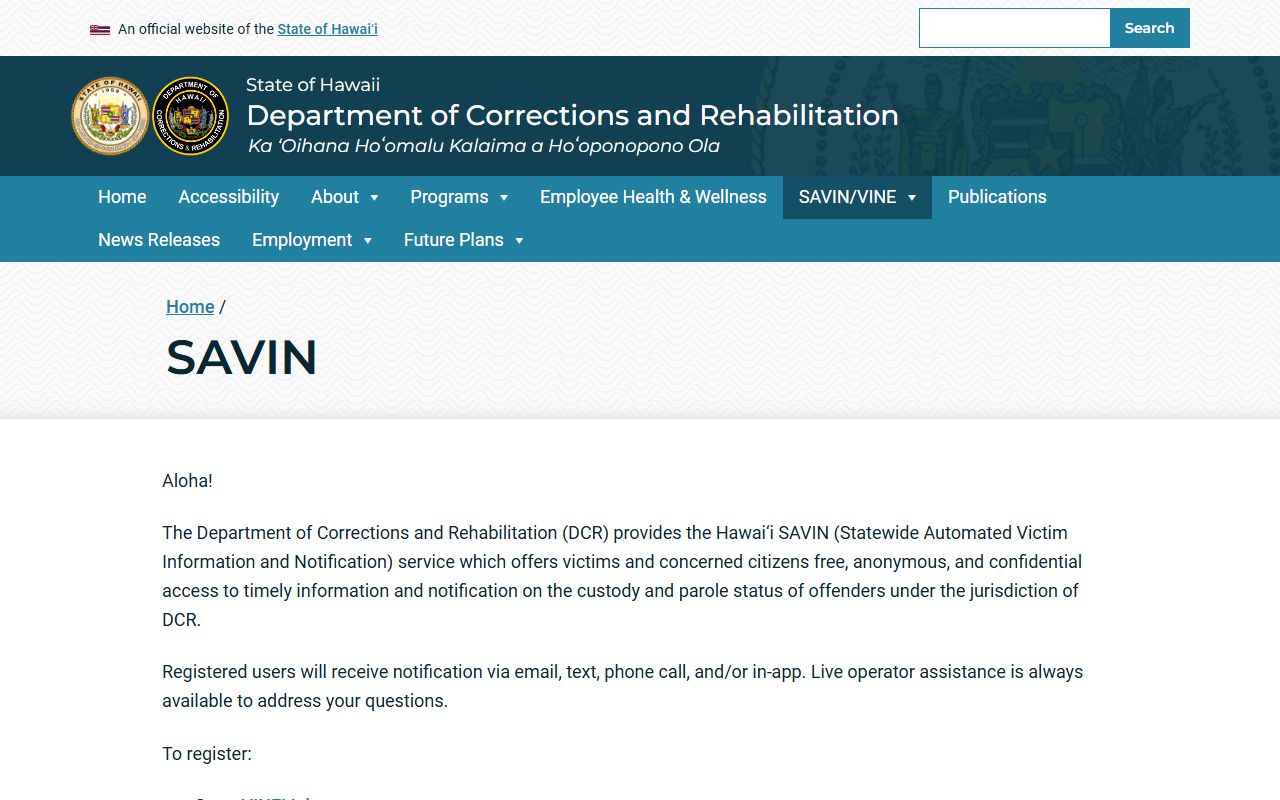
SAVIN is useful when the central issue is whether a person remains under Hawaii DCR custody or parole supervision.
MCCC Address and Contact
Contact MCCC when the question concerns facility rules, current public contact channels, visit timing, mail format, or money procedures. The main phone is not a substitute for a public court docket or police report. It is still the direct facility contact for Maui Community Correctional Center custody procedures.
Maui Community Correctional Center
600 Waiale Drive
Wailuku, HI 96793
(808) 243-5101
Visitation hotline: (808) 243-5861
Fax: (808) 244-0128
Hawaii DCR Central Office
1177 Alakea Street
Honolulu, HI 96813
(808) 587-1288
Fax: (808) 587-1282
MCCC Visitation Rules
MCCC procedures place the first step on the inmate. The inmate is responsible for completing a visitation list, and the list may include no more than 12 individuals. Visitor-list details include the visitor's name, current address, phone number, Social Security number, date of birth, and relationship to the inmate. Approval comes after the required process is complete. Visitors on probation or parole need written permission before they can visit.
The research did not locate a fixed current day-by-day MCCC public visiting schedule that should be copied into the page as permanent hours. MCCC procedures say visitation hours are updated often and direct users to the MCCC webpage or latest schedule. The safest reading is that visitors should use the visitation hotline and current DCR page before traveling, especially because Maui County travel can involve inter-island and long-distance planning.
| Topic | Official Detail |
|---|---|
| Visitation hotline | (808) 243-5861 |
| Visitor list | Completed by the inmate and limited to no more than 12 individuals |
| Approval | Visitors are approved after required processing is complete |
| Probation or parole visitors | Written permission is required |
| Schedule | Use the current MCCC page or visitation hotline because hours change |
MCCC Mail and Money
MCCC mail must use the inmate's first and last name, include the SID number when known, and route care of Maui Community Correctional Center. The procedures say general correspondence has no stated amount limit, but incoming and outgoing mail is monitored. Mail can be returned or delayed for missing names, no return address, stickers, glitter, glue, drawings, bookmarks, lipstick marks, inappropriate content, too many photos, or security concerns.
Money rules have both an older mail-in route and a later electronic route. The MCCC procedures describe cashier's checks by mail from approved visitors only, payable to Maui Community Correctional Center, with inmate and donor details and a maximum of $200 per inmate per month. A later DCR update says approved visitors can use GTL/ViaPath ConnectNetwork electronic deposits, with a $300 per inmate per month limit. Fees may apply, and funds generally transmit to the facility within one to two business days subject to DCR policy.
| Service | Provider or Detail |
|---|---|
| Mail address format | Inmate First/Last Name, SID number if known, c/o Maui Community Correctional Center, 600 Waiale Drive, Wailuku, HI 96793 |
| Phone calls | GTL provides local, inter-island, mainland, and international inmate calls |
| Video and tablets | GTL tablets support video visit calls and other program services |
| Mail-in money | Approved visitors may mail cashier's checks under the MCCC procedures, maximum $200 per month |
| Electronic deposits | GTL/ViaPath ConnectNetwork for approved visitors, maximum $300 per month, fees may apply |
MCCC Booking and Transfer
Maui arrest processing can begin with the Maui Police Department Receiving Desk / Wailuku Police Station, which official Maui County material identifies as a central booking and holding point for arrests. If detention continues, custody normally shifts to MCCC. That means a person may have an MPD police record first, an MCCC custody status next, and an eCourt Kokua case only after formal charges are filed. These are linked events, but they are not one record.
MCCC can hold pretrial felony detainees, pretrial misdemeanor detainees, sentenced misdemeanants, sentenced probationers, sentenced felons, parole violators, and other-jurisdiction holds. The March 31, 2026 legal-status breakdown listed 96 pretrial felony inmates, 9 pretrial misdemeanor inmates, 21 sentenced felons, 25 sentenced probationers, 6 sentenced misdemeanants, 14 other-jurisdiction inmates, and 41 parole violators. For court-charge detail after a Maui arrest, eCourt Kokua is the better source than a custody notification record.
Custody flow: Arrest by MPD or another agency, temporary police booking when applicable, MCCC custody if detention continues, then eCourt Kokua once public court charges exist.
MCCC Programs and Reentry
DCR lists MCCC programs that reflect the facility's mixed jail and reentry role. Programs include adult basic education, GED, parenting, cognitive skills, substance-abuse treatment, vocational training, work furlough, extended furlough with the Maui Intake Service Center, and drug court treatment. DCR also describes reintegration programs for sentenced felons and parole violators who will be released on Maui.
Program references are important because MCCC is not only a pretrial lockup. A person in MCCC custody may be there during a return-to-community stage after a prison sentence. DCR's program material names Thinking for a Change, Ka Ipu Haa mentoring through Mental Health America, outpatient substance-abuse treatment, Alcoholics Anonymous and Narcotics Anonymous meetings, assessed sex-offender treatment, Kamalama Parenting, and Maui Furlough.
The Hawaii Correctional System Oversight Commission annual reports page is relevant to MCCC because HCSOC tour reports discuss population, housing, and work-furlough use.
HCSOC's June 2025 tour report said only 5 people in custody were in work furlough despite capacity to accommodate at least 50 or more participants.
About MCCC History
MCCC's history is unusually clear in the DCR materials. The facility was built in 1978 with capacity for 24 inmates and later expanded into the only correctional center within Maui County. It sits on about seven acres in Wailuku, near the county government, court, police, and public-safety area. Its function is local, but its operator is state DCR. That combination explains why Maui County inmate record searches do not fit a standard sheriff-roster model.
MCCC and the MPD Receiving Desk are also separate addresses. MPD Records and the Wailuku Police Station are on Mahalani Street. MCCC is on Waiale Drive. Send police-report requests to MPD records, not MCCC. Use MCCC and DCR channels for jail custody, visits, mail, money, phones, tablets, and facility programs. For a broader Maui County inmate population overview, the Maui County inmate population page distinguishes state DCR custody from police and court records.
Note: Confirm custody status, visit approval, and the current schedule with MCCC before traveling to Waiale Drive.